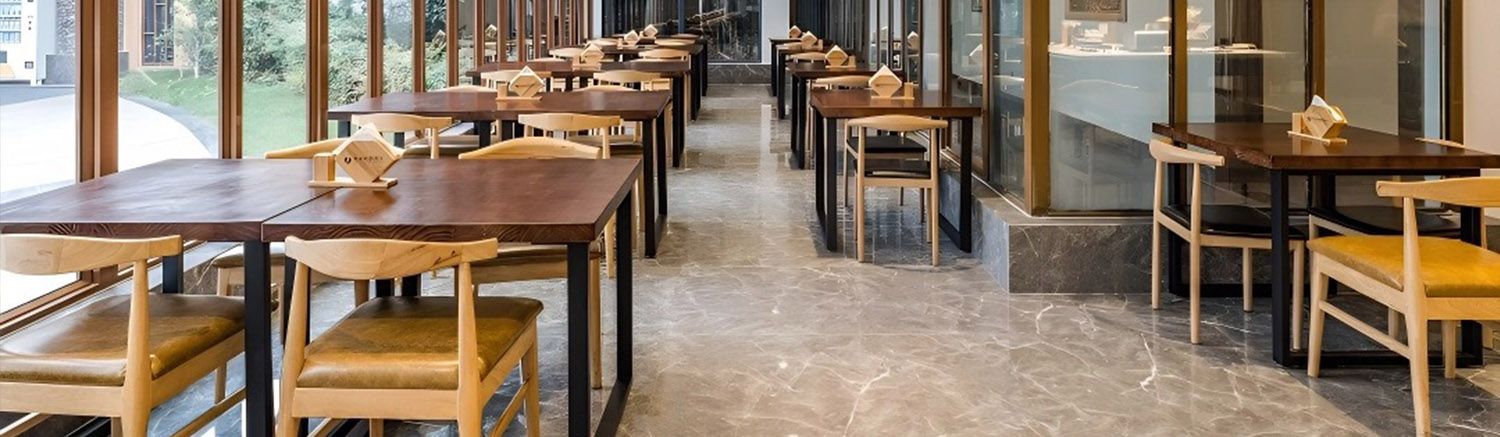
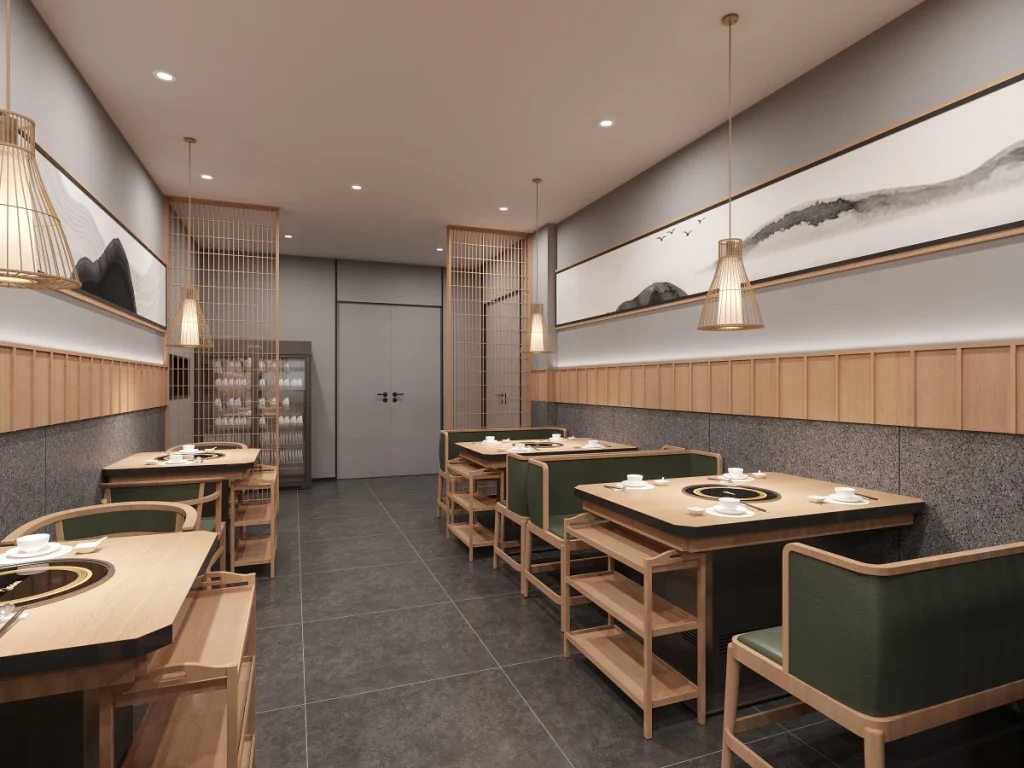
For high-traffic hot pot restaurants, the tabletop is a core component that directly affects store operation efficiency. Scorching hot pot bases, oil-heavy soup, and acidic dipping sauces constantly test the performance of board materials. Many catering operators struggle to figure out which type of hot pot restaurant tabletop among sintered stone, quartz, and marble can balance high turnover rates, easy cleaning, and long-term high-frequency use. With years of experience in custom catering furniture, Konma has implemented thousands of tabletop solutions for catering establishments, with real project verification of its strength——for example, in a large hot pot chain project in Ulaanbaatar, we replaced all the original quartz tabletops with Konma custom sintered stone. The store reported that the monthly average cleaning consumable cost was reduced by 15%, and the long-standing problem of discoloration around the stove was solved. Today, we deeply analyze the adaptability of the three materials based on professional tests, real cases, and concrete comparisons.
Anyone running a hot pot restaurant knows that turnover speed depends not only on front-of-house service but also on the cleaning speed of the tabletop, which directly determines customer flow efficiency. Even if the cleaning time of a single table is shortened by half a minute, a store receiving hundreds of customers daily can serve more than a dozen extra tables per day, which has a significant long-term impact on store revenue. The special nature of hot pot scenarios is far different from ordinary catering spaces: continuous high-temperature baking from pot bases, easy penetration of oil soup, and corrosion from acidic condiments like vinegar and lemon are all key challenges when selecting high-turnover hot pot tabletop materials.
In fact, there is a simple and easy-to-understand logical comparison between cleaning efficiency and turnover efficiency, and the gap can be seen clearly without complex calculations:
Cleaning efficiency logic: Fewer cleaning steps + shorter time consumption = higher cleaning efficiency; Turnover efficiency logic: Shorter cleaning time + stronger tabletop durability = shorter turnover interval = higher turnover rate.
We have made a set of concrete comparisons based on the real cleaning scenarios of hot pot restaurants, and the gap is obvious at a glance:
It’s easy to understand with a simple calculation: Stores using sintered stone tabletops save 70 seconds per table cleaning compared with marble. During peak customer flow (such as 3 hours during dinner time), they can turn over 0.5-1 more tables per hour, and serve 10-20 more customers per day. For catering stores pursuing high turnover, this is undoubtedly the key to increasing revenue.
Combined with the actual use needs of the catering industry, we have compiled this parameter comparison table with professional testing institutions. All data are measured based on commercial-grade boards, which are more suitable for the high-frequency use scenarios of hot pot restaurants:
| Performance Indicators | Sintered Stone | Quartz | Marble | Commercial Adaptability Priority for Hot Pot Restaurants |
| Mohs Hardness | 7-8 grades | 5-6 grades | 3-5 grades | Sintered Stone > Quartz > Marble |
| Water Absorption Rate | ≤0.01% | 0.05%-0.12% | 0.3%-0.6% | Sintered Stone > Quartz > Marble |
| Maximum Heat Resistance | 1300℃ | 280℃ | 180℃ | Sintered Stone > Quartz > Marble |
| Acid & Alkali Corrosion Resistance | Food-grade super tolerance | Medium tolerance (resin prone to corrosion) | Weak tolerance (easy to lose luster and discolor) | Sintered Stone > Quartz > Marble |
| Stain Penetration Resistance | Zero penetration | Low penetration | High penetration | Sintered Stone > Quartz > Marble |
| Daily Maintenance Cost | Extremely low, clean with water only | Medium, requires neutral detergent | Extremely high, needs regular glazing maintenance | Sintered Stone > Quartz > Marble |
| Commercial Service Life | 10-15 years | 5-8 years | 3-5 years | Sintered Stone > Quartz > Marble |
In fact, hot pot sintered stone tabletops have become the first choice for commercial use due to their nanoscale dense structure. They have no micro-pores like natural stone nor resin shortcomings like synthetic stone, fundamentally eliminating oil penetration and high-temperature deformation, which is an advantage that ordinary quartz and marble cannot match. Just like the hot pot chain in Ulaanbaatar, after replacing with Konma sintered stone, it not only solved the problem of yellowing around the quartz stone stove but also significantly reduced the operating cost by saving cleaning consumables.
Natural marble is often used in high-end catering spaces for its unique texture, but it hides many hidden dangers when used in high-traffic hot pot restaurants. Its internal physical micro-pores act like tiny channels. Once heavy-color stains such as red oil and soy sauce penetrate, they cannot be removed by conventional cleaning. Over time, permanent color spots will form on the tabletop, which not only affects the store’s image but also easily breeds bacteria, failing to meet catering hygiene standards. Maintaining its appearance requires regular professional glazing, and the additional maintenance costs are not cost-effective for stores pursuing high turnover.
Quartz hot pot tabletops perform well in hardness and stain resistance in daily catering scenarios, but the continuous high temperature of hot pot is their fatal weakness. The resin binder contained in quartz will slowly turn yellow and crack under continuous baking above 280℃, especially in the area directly below the stove, where the traces are particularly obvious. For chain catering stores focusing on a unified visual image, yellowing and mottled tabletops will directly lower the brand texture, and later tabletop replacement will increase store renovation costs. This is the core reason why the hot pot chain in Ulaanbaatar was eager to replace the tabletops.
On the other hand, sintered stone, the benchmark of easy-clean catering tabletops, is formed by 10,000-ton high pressure and high-temperature calcination. It contains no glue or resin, is not only high-temperature resistant and corrosion-resistant, but also has strong hydrophobicity. Oil stains after meals will not adhere or penetrate when spilled on the surface. Cleaning staff can restore the surface to cleanliness with a ordinary wet cloth, without using chemical consumables such as detergent and descaling agent, saving cleaning time and reducing consumable expenses, perfectly adapting to the fast-paced operation of high-traffic hot pot restaurants.
To restore the real use scenarios of hot pot restaurants, Konma specially conducted two strict commercial tests on the three boards, and the results directly confirm the gap between different materials:
Hot pot restaurants with different positioning have different needs for tabletops. Combined with operation modes and brand styles, the following selection directions can be referred to:
Q: Is sintered stone tabletop compliant with food contact safety standards for hot pot restaurants?
A: The commercial-grade sintered stone selected by Konma has passed food contact level testing, no harmful substances are precipitated, and it is safe and harmless even in direct contact with food, fully meeting the hygiene compliance requirements of catering stores. This is one of the core advantages that we can successfully undertake chain hot pot projects.
Q: When customizing hot pot tabletops in batches, can the size and texture of sintered stone be personalized?
A: Of course. Konma supports personalized services such as size cutting, texture customization, and edge polishing of hot pot sintered stone tabletops. Exclusive design can be made according to the table specifications of stores and brand visual styles, adapting to the layout needs of different stores. Whether it is single-store customization or batch supply for chains, it can be flexibly adapted.
Q: Besides glazing, are there other ways to extend the service life of marble tabletops?
A: In daily use, acidic stains and heavy-color oil stains should be wiped in time to avoid long-term retention. At the same time, avoid heavy collision with sharp tableware. Matching with special stone maintenance agent can prolong the service life to a certain extent, but still cannot match the durability of sintered stone, nor can it reduce the long-term maintenance cost.
Q: Is it possible to repair quartz tabletops after yellowing?
A: The yellowing of quartz is caused by internal changes due to resin aging, which cannot be repaired by cleaning or polishing, and only local tabletop replacement is possible. This is the core reason why it is not recommended for long-term use in high-traffic hot pot stores. Just like the chain hot pot in Ulaanbaatar, it was precisely because the yellowing problem of quartz stone was difficult to solve that it chose to replace it with Konma sintered stone.
Q: Although sintered stone is wear-resistant, is its edge prone to chipping?
A: Konma adopts 3D chamfering technology (R-angle edge grinding), which effectively disperses the edge impact force and solves the pain point of traditional flat sintered stone being easy to chip. Whether it is daily tableware collision or slight collision during batch transportation and installation, it can effectively avoid edge chipping, adapting to the high-frequency use scenarios of catering stores.
Q: How to match sintered stone hot pot tables with built-in induction cookers?
A: We provide high-precision CNC hole opening, combined with fireproof and heat-insulating sealing rings, to ensure that the edge of the induction cooker is not water leakage and not hot. At the same time, it accurately matches different models of built-in induction cookers, taking into account the safety of use and the integrity of the tabletop. There is no need to worry about installation problems caused by hole opening deviation. The induction cooker specifications can be docked in advance during batch customization to achieve seamless adaptation.
In the operation of catering stores, a suitable tabletop is never a simple furnishing, but a key tool to improve turnover and reduce operating costs. With the core advantages of zero penetration, super heat resistance and easy cleaning, sintered stone has become the optimal solution for high-traffic hot pot restaurants; quartz is suitable for small and medium-sized stores with limited budgets; marble is more suitable for high-end catering spaces with low customer flow and high style emphasis.
Konma has focused on custom catering furniture for many years, and is well aware of the tabletop use needs of various catering stores. It not only has successful cases like the Ulaanbaatar chain hot pot, but also can provide a one-stop catering tabletop customization service from design, production to installation. Whether it is batch supply of hot pot sintered stone tabletops for chain stores or personalized tabletop design for single stores, we can create exclusive solutions combined with store operation characteristics, making tabletops truly a boost to improve store operation efficiency.
In dimly lit business scenarios such as nightclubs and […]
Light misalignment of restaurant booths is a long-stand […]
Stepping into a high-end Japanese restaurant, visitors […]
Operational managers of chain dining brands always stru […]
Related links:
About us Company News Industry Dynamics Table Chair Outdoor-furniture Sofa Latest dining chair Other SSL 100% Secure Transactions