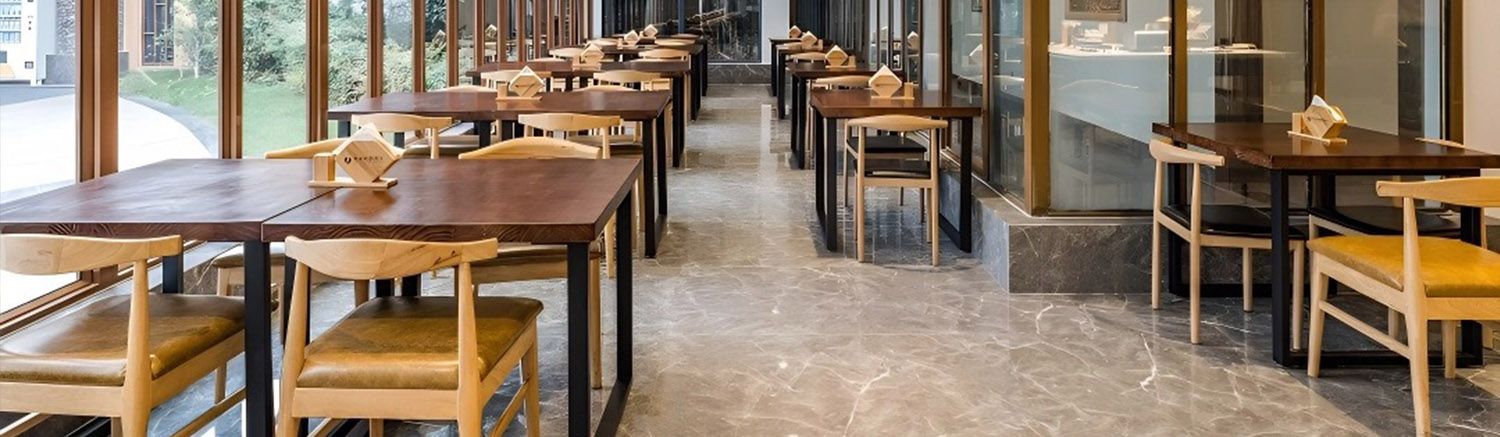
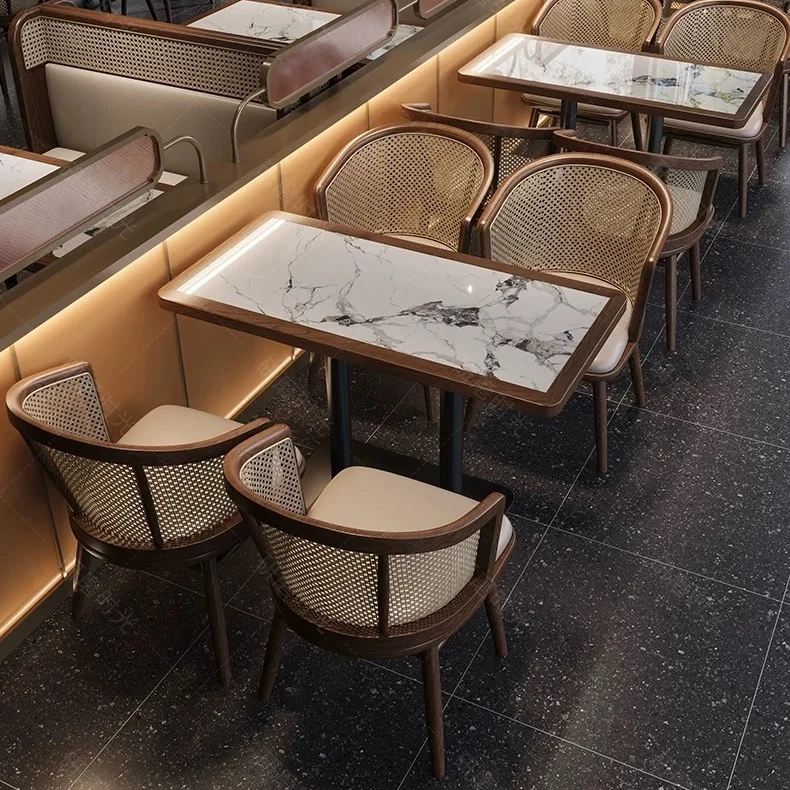
In restaurant space planning, choosing the right table size is never a casual decision. An overly narrow table leaves customers with no space for tableware, directly ruining the dining experience, while an overly large table occupies public aisles, wastes core store space, and reduces overall turnover efficiency. With years of deep experience in custom restaurant furniture at Konma, we have served various catering establishments, from street-side fast food shops to high-end private dining restaurants. We have found that the core logic of table size always revolves around the “plate adaptation rule”—the dining form, number of tableware, and social needs of different catering formats directly determine the optimal table size, which is also the key to creating a comfortable dining space and efficient space utilization, and even the core factor affecting the store’s restaurant seating capacity optimization.
Many catering operators fall into a misunderstanding: table size only affects customer experience and has nothing to do with operational efficiency. In fact, table size is an invisible key to determining turnover rate—when the size matches the format, it can make customers’ meals smoother and waiters’ services more efficient; otherwise, it will lead to turnover delays and space waste.
The core demand of the fast food format is “efficient turnover”. Customers mostly dine immediately and leave after eating. The core of fast food table dimensions is “compact and practical”, requiring no extra space, just enough to hold trays, tableware and drinks. An overly wide table will extend customers’ stay time and reduce turnover efficiency; while the core of high-end fine dining is “experience”. Fine dining table planning emphasizes spaciousness and comfort. Multiple courses, wine glasses and table decorations all need sufficient space. An overly narrow table will make customers feel cramped, and even affect customer unit price and repurchase rate.
When customizing tables for customers, Konma first clarifies the turnover needs of the format, then matches the corresponding size—fast food focuses on compactness and efficiency, fine dining focuses on comfort and spaciousness, and shareable plates balance socialization and practicality, making table size a “booster” rather than a “stumbling block” for turnover rate from the root.
Combined with the latest 2026 catering space design specifications and thousands of Konma’s landing cases, we have sorted out the restaurant table size standard for different catering types, added a column of typical tableware load, clearly presenting the correlation between size, tableware and turnover rate, balancing practicality and space adaptability:
| Catering Format | Standard Size for 2-Person Table | Typical Tableware Load | Impact on Turnover Rate | Core Usage Features |
|---|---|---|---|---|
| Fast Food | 60×60cm | 1-2 standard trays (including staple food, drinks and snacks, no extra tableware) | Extremely high: Customers leave immediately after eating, not suitable for long stays, adapting to high-frequency turnover needs, which is the core standard of fast food table dimensions | Suitable for tray-based dining, easy-to-clean tabletop, compact layout, maximizing space utilization, suitable for burger shops, coffee shops and convenient dining stores |
| Shareable Plates (Tapas) | 80×80cm minimum | 6-10 small plates + central turntable/shared tableware (including snacks, sauces and drinks, requiring reserved shared space) | Medium: Strong social attribute, long dining time, moderate turnover rate, need to optimize through shareable plates table size to improve efficiency | Multi-plate shared dining, need to reserve central public area, adapting to social dining needs, suitable for tapas bars, fusion cuisine and light food collection stores |
| High-End Fine Dining | 90×90cm | Multiple courses (appetizers, main courses, desserts) + wine glass set (red wine glass, water glass, champagne glass) + decorative ornaments (table flowers, candlesticks) | Low: Pursue immersive experience and high customer unit price, do not pursue high-frequency turnover, focus on improving customer retention through comfort | Multi-course table setting, capable of holding wine glasses, cutlery and soft furnishings, fitting the high-end experience needs of fine dining table planning, suitable for steak houses, Michelin restaurants and business private banquet stores |
Note: The above data is compiled by Konma based on 2026 catering operation data. The actual size can be flexibly adjusted according to the store space and customer positioning. Konma can provide one-on-one size customization services to accurately match the format needs.
In addition to basic size and tableware load, there are many details that directly determine the user experience and space adaptability of the table. These are also the core considerations when Konma customizes solutions for customers, and even the bonus points of professional catering space planning:
For most catering stores, limited space is the norm. To achieve restaurant seating capacity optimization, the selection and combination of tables are far more important than simply reducing the size, which is also the core focus of Konma’s customized solutions for catering customers, and the 60×60cm square table is the “golden size” for modular combination.
The core advantage of the 60×60cm square table is “flexible splicing”. Compared with round tables of fixed sizes, it has a strong modular combination ability: two 60×60cm fast food square tables can be spliced to form a 120×60cm four-person dining seat, adapting to small gatherings; three spliced tables can form an 180×60cm six-person seat. No additional furniture is needed to flexibly cope with peak and off-peak passenger flows.
This modular restaurant table combination method not only does not sacrifice the customer dining experience, but also makes every inch of the store’s space play a value. Compared with traditional round tables, the space utilization rate can be increased by 15%-25%. For stores with limited space, Konma’s foldable and retractable tables can also be selected, which shrink to save space in idle time and expand to increase capacity during peak passenger flows, perfectly balancing floor efficiency and experience; for chain catering stores, modular tables can also reduce furniture procurement and replacement costs, realizing standardized layout.
Konma’s 60×60cm square table is made of wear-resistant and easy-to-clean materials, suitable for various formats such as fast food, casual dining and light food. The table corners are rounded to balance safety and beauty, and the size can be fine-tuned to flexibly adapt to the actual space of the store, helping the store maximize floor efficiency.
Combined with the actual consultations of a large number of catering customers, we have sorted out high-frequency questions and given standardized answers, covering core needs such as size selection, space estimation and format adaptation, helping operators avoid pitfalls quickly:
Q1: Can the 60×60cm fast food table be barely used for fine dining?
A: It is not recommended at all. Fine dining requires placing multiple sets of tableware, wine glasses and decorative arrangements. A 60×60cm table will leave no space for tableware, making customers’ dining posture cramped and even affecting conversation. Even if space is limited, a 70×70cm table should be selected as a compromise plan to ensure the basic dining experience and avoid affecting customer unit price due to poor experience.
Q2: How to choose the table width for bar-style catering stores?
A: It depends on the bar usage form. The table width of a wall-mounted single-sided bar only needs 40-50cm to meet the needs of single-person dining without occupying too much aisle space; the table width of a two-way opposite bar needs to reach 60-80cm, which can not only ensure the dining space for customers on both sides but also not affect the waiter’s service in the middle, while reserving space for tableware placement.
Q3: Is there a general reference standard for table sizes in restaurants for multi-person gatherings?
A: There is a clear reference standard. For gatherings of eight or more people, the diameter of the round table should be no less than 150cm, and the square table should be 240×90cm. It is necessary to ensure sufficient food placement and reserve space for customers to pick up dishes and converse; for ten or more people, it is recommended to choose spliceable square tables to flexibly adjust the size, avoiding space waste caused by fixed large tables.
Q4: How to adapt the table size for dessert shops and beverage shops to light food formats?
A: Light food formats do not require large-sized tables, and the core is “compact, clean and practical”. A 50×50cm single table and a 60×60cm double table are sufficient, focusing on table cleanliness and small object placement (such as mobile phones, power banks and small tableware), fitting the fast and casual dining characteristics of light food. At the same time, Konma’s small side tables can be matched to improve space utilization.
Q5: How to estimate the number of dining seats according to the total store area?
A: In general catering space planning, it is recommended to estimate at 1.2 – 1.6 square meters per person (including aisles). Fast food stores can be compressed to 1.0 – 1.2 square meters per person, focusing on improving density through compact fast food table dimensions to adapt to high-frequency turnover; while high-end fine dining requires 1.8 – 2.2 square meters per person, focusing on ensuring dining comfort and fitting the needs of fine dining table planning. Reasonable table size selection is the key to controlling this ratio. Konma can accurately calculate the matching plan of the number of dining seats and table size according to the total store area.
The table of a catering store is not only a dining carrier but also the core furniture that affects space experience and operational efficiency. Especially for catering brands pursuing standardized and efficient operations, customized tables are the key to improving competitiveness.
Konma has focused on custom restaurant furniture for many years, deeply cultivating various catering formats. It can tailor the appropriate table size and style according to the store format, space pattern, customer group characteristics and turnover needs. From size planning, material selection (wear-resistant, easy-to-clean, non-slip) to structural design (modular, spliceable, ergonomic), it fully fits the store’s operational needs. Whether it is a fast food store pursuing high turnover efficiency, a shareable plates store focusing on social experience, or a fine dining restaurant focusing on high-end experience, Konma can make the space more reasonable, the experience more comfortable and the operation more efficient through professional table customization solutions, ultimately helping the store improve operational efficiency and customer reputation.
In 2026, the competition in the catering industry has i […]
During late-night clearing in banquet halls, hotel mult […]
When selecting a long-term furniture supplier, the prof […]
In dimly lit business scenarios such as nightclubs and […]
Related links:
About us Company News Industry Dynamics Table Chair Outdoor-furniture Sofa Latest dining chair Other SSL 100% Secure Transactions