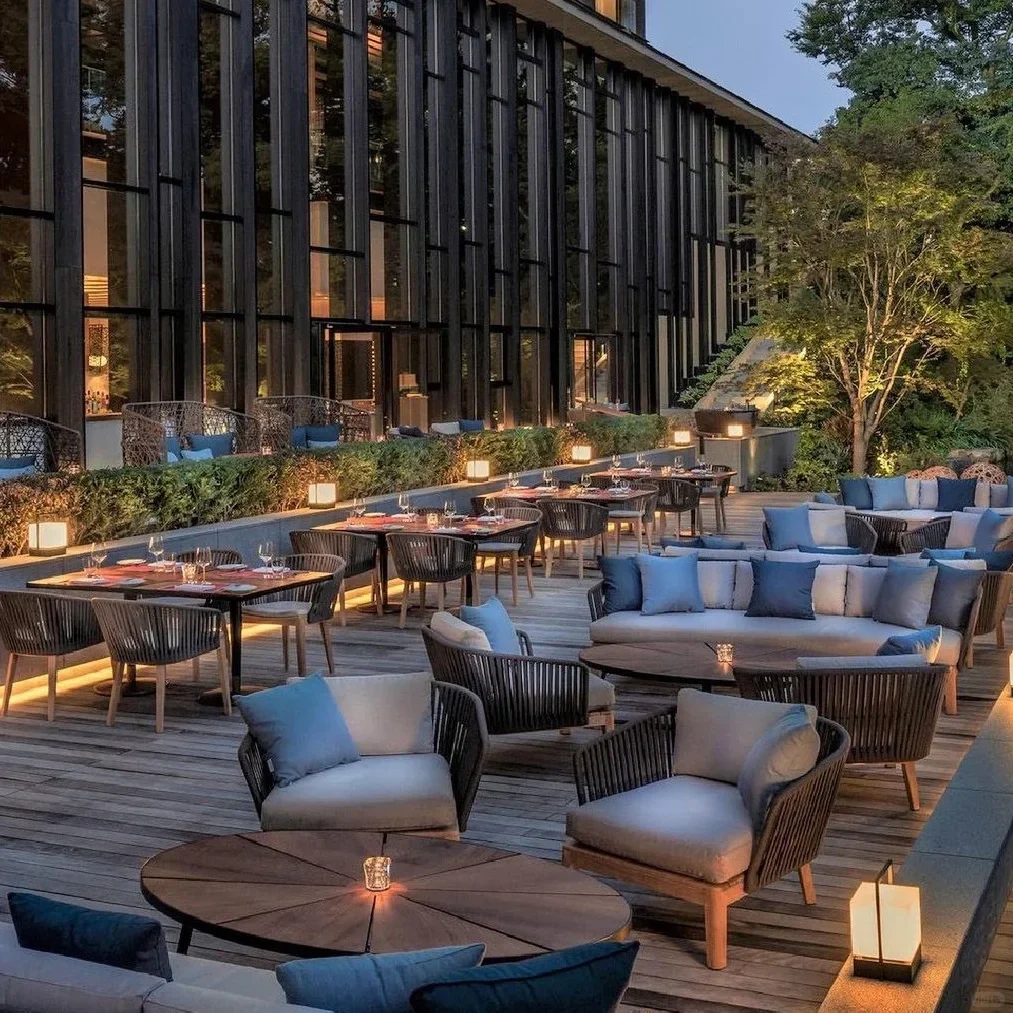
In high-temperature areas where the average daily UV index exceeds 11 for months in summer and midday temperatures hit 52°C, the sunlight here is the harshest natural endurance test for outdoor furniture, especially pieces made with outdoor woven rattan. Even the smallest oversight can lead to cracking, discoloration, and chipping within 6 months, directly undermining the user experience and operational efficiency of the space.
Speaking of which, most people only think rattan discoloration ruins the aesthetic, without realizing that discoloration is just the first warning sign of material degradation. We ran a 12-month field exposure test at our partner site in high-temperature areas, and found that rattan with obvious yellowing after 3 months saw its tensile strength drop by more than 60% at the 6-month mark, snapping with just a gentle bend and completely losing its load-bearing capacity. What many people don’t know is that the extreme environment in high-temperature areas damages rattan in two ways: UVA and UVB rays directly break the molecular chains of the rattan, triggering photo-oxidation reactions that make the material brittle and chalky; while sustained high temperatures over 50°C, paired with a nearly 30°C temperature difference between day and night in desert regions, repeatedly stretch and stress the material structure, accelerating aging and fatigue. This is exactly why the same rattan can last 5 years in temperate regions, but may not even survive 1 year in high-temperature, high-UV areas.
There are two core categories of outdoor woven rattan on the market: 100% virgin PE rattan and recycled plastic rattan, and their weather resistance is worlds apart from the raw material stage. Recycled plastic rattan is mostly made from repeatedly recycled industrial waste plastic and daily plastic bottle materials, whose molecular chains have already been broken and damaged during repeated processing. Even with a UV-resistant coating sprayed on the surface, it only treats the symptoms, not the root cause. In most cases, this type of recycled rattan will show visible color difference in 3 months under the intense UV environment of high-temperature areas, and will become brittle and crack within 6 months, completely failing to meet the requirements for long-term use. In contrast, 100% brand-new high-density virgin PE rattan has a complete linear molecular structure, with inherent advantages in the stability and tensile resistance of the material itself, laying a solid weather-resistant foundation for the rattan. This is the core basis for UV-resistant outdoor woven rattan to withstand extreme sun exposure. At Konma, when producing weatherproof outdoor furniture, we refuse to add any recycled materials from the source, and all rattan uses brand-new food-grade virgin PE particles, eliminating hidden aging risks from the raw material end.
In fact, a virgin PE base alone is far from enough. What really determines whether the rattan can resist discoloration and cracking after 1 year of sun exposure in high-temperature areas is the UV stabilizer system in the formula. Many low-cost products claim to have “added UV inhibitors”, but most only spray a thin coating on the surface, which is quickly destroyed by daily wiping and sand abrasion, and the UV resistance drops to zero immediately. A truly effective UV protection solution is to integrate the compound UV stabilizer into the molecular structure of the raw material before the rattan is extruded, rather than just doing superficial work. In our actual tests, we found that a formula compounded with Hindered Amine Light Stabilizers (HALS) and UV Absorbers (UVA) can form a complete protection network: the UV absorber first absorbs most harmful rays and converts them into harmless heat energy, and the HALS then intercepts the escaped free radicals, preventing the photo-oxidation reaction from continuing, adding double-layer protection to the rattan from the inside out.
When it comes to UV fade resistance, the core indicator that cannot be avoided is ISO 105-B02 light fastness rating, which is also the globally accepted core judgment standard for sun resistance of commercial outdoor furniture. Many merchants will casually boast that their products “do not fade”, but without the grade endorsement of this standard, it is all empty talk. In this standard, light fastness is divided into grades 1 to 8, with grade 1 being the worst and grade 8 the highest. The gap in actual use performance between different grades in high-temperature areas is far greater than you can imagine. Grade 4 light fastness is only entry-level for residential use, and will show obvious visible color difference in 3 months under the intense UV environment of high-temperature areas; grade 5 can last for about 6 months; only when the light fastness reaches grade 6 and above can it be regarded as commercial-grade UV-resistant rattan, which will show almost no visually perceptible color difference after 12 months of sun exposure in high-temperature areas; while products reaching grade 7-8 can maintain stable color even after 3 years of continuous sun exposure.
We have completed a full 3000-hour xenon arc aging test in conjunction with the raw material laboratory – this test duration is completely equivalent to 12 months of natural sun exposure in high-temperature areas, and can most intuitively reflect the real weather resistance of different rattans. The specific test data are as follows:
| Testing Metrics | Recycled Plastic Rattan | Regular Virgin PE Rattan | Konma Commercial-Grade PE Rattan (REHAU/VIRO) |
|---|---|---|---|
| ISO 105-B02 Light Fastness | Grade 2-3 | Grade 4-5 | Grade 7-8 (Top-Tier Weather Resistance) |
| 3000h Xenon Arc Aging Test Performance | Severe Brittleness & Fracture | Surface Chalking & Yellowing | Tensile Strength Retention >90% |
| UV Protection Technology | No Protection or Surface Coating Only | Single Additive | Molecular-Level Compound Light Stabilizer System |
| Predicted Service Life in High-Temperature Areas | < 6 Months | 1 – 2 Years | 5 – 10 Years |
Combined with more than ten years of production experience in outdoor rattan furniture and project implementation in high-temperature areas, we have sorted out 4 core selection criteria for high-quality UV-resistant outdoor woven rattan. Even if you know nothing about raw materials, you can avoid 90% of the pitfalls by following these points:
Step 1: Dust Removal After Sandstorms. Never wipe directly with a wet cloth. First use cold air to blow off floating sand in the gaps of the rattan, then use a soft brush to clean residual fine sand along the weaving texture to avoid abrasion to the UV protection layer on the rattan surface.
Step 2: Cleaning with Neutral Warm Water. For daily cleaning, use neutral detergent with warm water around 30°C. After gentle wiping, rinse with clean water and dry in a cool and ventilated place, to avoid strong alkaline detergents damaging the UV-resistant molecular structure inside the rattan.
Step 3: Annual Physical Reinforcement. Complete a full product inspection every year, check the weaving tension of the rattan, and timely tighten the loose parts caused by thermal expansion and contraction, to avoid structural deformation accelerating local wear and aging.
Q: When customizing commercial outdoor rattan furniture, how can I clarify the UV resistance standards in procurement to avoid pitfalls?
A: The most direct way is to clearly mark two core indicators in the procurement requirements: first, the ISO 105-B02 light fastness rating shall not be lower than grade 6, and second, the tensile strength retention rate after 3000-hour xenon arc aging test shall not be lower than 85%. At the same time, require the supplier to provide the corresponding raw material test reports and field exposure test data, and do not just listen to verbal promises. All UV-resistant outdoor furniture from Konma can provide complete raw material test reports and actual measurement data, and support re-inspection by third-party institutions.
Q: Does light-colored rattan absorb heat and fade more easily than dark-colored rattan?
A: This is the most common misconception. In fact, the fading speed of rattan has no absolute correlation with the depth of color. The core is still the light resistance grade of the color masterbatch and the compound formula of UV stabilizers. In our actual tests, we have seen many inferior white rattans that turn severely yellow in 3 months, while high-quality black rattans show no fading after 1 year of sun exposure, which is exactly the reason.
Q: For rattan used in outdoor patio furniture for high-temperature areas, what other properties should I pay attention to besides UV resistance?
A: In addition to the core UV weather resistance, there are three key points to focus on: first, chemical resistance, which can withstand the corrosion of common stains such as sunscreen, pool chlorine water, carbonated drinks, and coffee, without discoloration or bulging caused by spills; second, sand abrasion resistance, with high surface smoothness, not easy to be embedded with sand and worn; third, flame retardant performance, which meets the fire safety requirements of commercial spaces. These are all details that Konma focuses on in product design.
Q: What is the normal service life of anti-aging PE rattan?
A: Under the extreme sun exposure environment of high-temperature areas, high-quality virgin PE rattan with color fastness above grade 6 can reach a service life of 5-8 years under normal maintenance; high-end rattan with grade 7-8 color fastness can reach a service life of more than 10 years; while recycled plastic rattan mostly has a service life of no more than 1 year.
Q: How much will the initial procurement cost increase when purchasing rattan furniture with excellent UV resistance?
A: Furniture made of virgin PE rattan and high-performance UV stabilizers usually has a unit price 30%-50% higher than ordinary recycled material products. But from the perspective of Total Cost of Ownership (TCO), ordinary rattan needs to be replaced every six months in high-temperature areas, while Konma products have a service life of more than 5 years, and the actual annual average holding cost is only 20% of that of inferior products.
At the end of the day, whether weather-resistant outdoor furniture for high-temperature areas can be used stably for a long time under the scorching sun never depends on luck, nor on the verbal publicity of merchants, but on strict control of raw materials, scientific UV protection formula system, and solid test data support. Konma has been deeply engaged in the outdoor furniture field for many years. Before mass production of each rattan product, it will first go through a 3000-hour xenon arc aging test in the laboratory, and then a 12-month field exposure test at our partner site in high-temperature areas, to ensure that every product can adapt to the extreme high-temperature and high-UV climate, and bring customers a long-term and stable use experience.
Many friends who run Western restaurants ask us when cu […]
Bars have long been a core social hub for young people— […]
Most catering venues suffer from sharp outdoor passenge […]
The choice of outdoor restaurant furniture is always a […]
Related links:
About us Company News Industry Dynamics Table Chair Outdoor-furniture Sofa Latest dining chair Other SSL 100% Secure Transactions