Home / News / Industry Dynamics / 2026 Restaurant Design Trends: What Sintered Stone Tables and Curved Booths Say About Your Brand
2026 Restaurant Design Trends: What Sintered Stone Tables and Curved Booths Say About Your Brand
2026-11-05
Trend lists are usually written by people who have never loaded a chair into a container. This one is written from the other side — the factory floor — where you can read the direction of restaurant interior trends 2026 not in moodboards, but in what operators actually order. In the last year, two shifts have moved from “design magazine territory” into standard procurement briefs: tables surfaced in sintered stone, and booths that trade hard corners for curves.
Neither trend is really about looks. Both are statements your restaurant makes to every guest who walks in — and both have practical reasons underneath, which is why they will outlast the season.
Trend 1: Sintered Stone Tables — The Surface That Signals “We Sweat the Details”
What guests actually notice
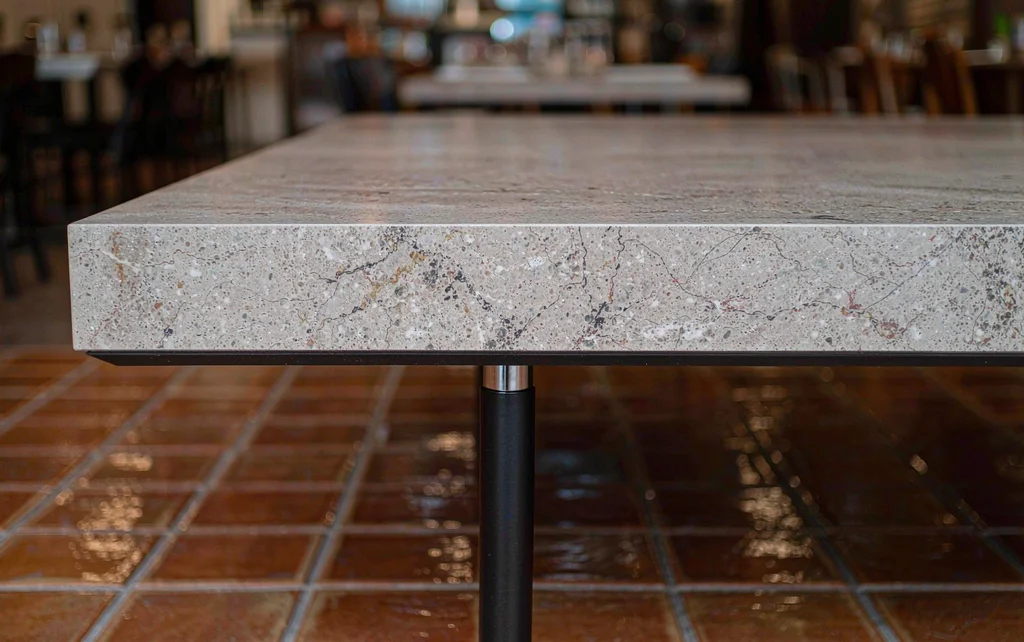
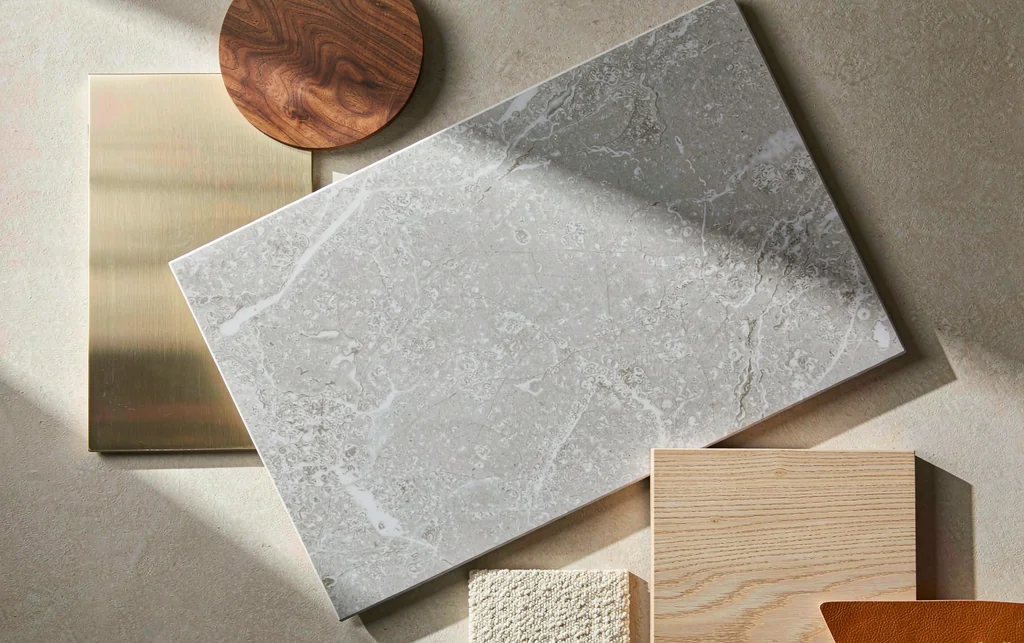
Sintered stone reads differently from laminate or quartz the moment a guest sits down. The surface is cool to the touch, the finish is matte rather than glossy-plastic, and the pattern runs through the slab instead of sitting as a printed layer on top. Most guests will never say the words “sintered stone.” They will say the table looks expensive, and they will be right.
What operators actually notice
The real story is operational. A sintered stone dining table for restaurants handles a hot serving dish straight from the kitchen, shrugs off red wine and turmeric, and tolerates the industrial sanitizers that would haze a lacquered surface within months. There is a hygiene angle too: the material is non-porous, so it does not absorb oils or odors the way some natural stones and woods eventually do.
How it compares against the two surfaces most operators are choosing between:
Property
Sintered stone
Engineered quartz
High-pressure laminate
Hot plates straight from the pass
Handles it
Needs trivets/trays
Damages easily
Acidic spills (wine, citrus, vinegar)
No effect
Can dull resins
Stains/discolors over time
Industrial sanitizer daily wiping
Stable
Stable
Finish hazes within months
Porosity / odor absorption
Non-porous
Near non-porous
Porous edges if unsealed
Impact/chip resistance
Moderate
Moderate
Moderate
Pattern depth
Through-body
Through-body
Printed layer only
Positioning
Premium rooms
Mid-to-premium
Volume/QSR
How to spec it
Thickness: 12 mm slabs handle commercial service; anything thinner starts to need full under-support.
Edge profile: a mitered edge gives the look of a thick slab without the weight on the base — ask for it explicitly, it is a no-cost visual upgrade at order time.
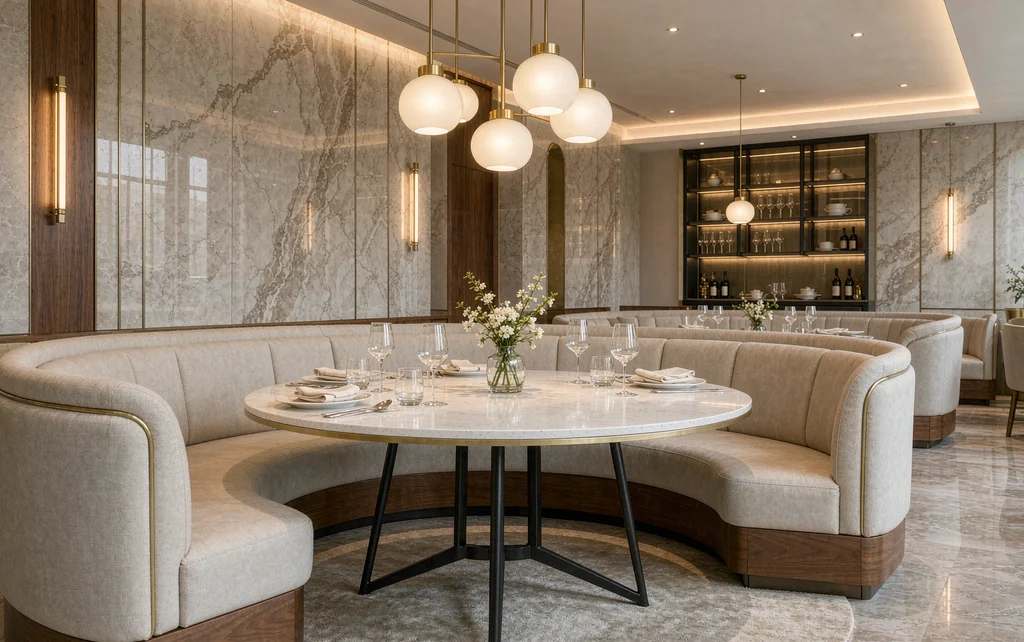
Base pairing: the current direction pairs light stone tops with slim black or champagne metal bases, which visually “floats” the top. Our round sintered stone dining table with gold trim is a good reference for the proportion shipping this year.
Where not to use it: outdoor terraces with heavy impact risk and budget-driven QSR rollouts — sintered stone earns its keep where the room is designed to feel premium.
Trend 2: Curved Booths — Geometry as a Brand Statement
Why corners are disappearing
Curved banquette seating does three jobs at once:
Comfort signal — it wraps a table in a semi-private pocket, which guests read as intimacy, and softens the noise that bounces off straight-run seating.
Photography — a curved back line gives every table its own shape in a frame, instead of the repeated rectangles of standard runs.
Flow — a curved perimeter guides movement around the room instead of blocking it.
A curved restaurant booth seating cluster, in short, says something a straight booth can’t: this room was designed, not furnished.
Curved versus straight, in practice
This isn’t a replacement — it’s a zoning decision. The two layouts earn their keep in different parts of the same room:
Dimension
Straight booths
Curved booths
Seats per meter of wall
Highest
10–15% lower (approx., layout-dependent)
Guest dwell tendency
Turn-and-go
Stay longer, order more rounds
Noise behavior
Reflects along the run
Absorbs/softens at the pocket
Photographic value
Repeating pattern
Each table gets its own silhouette
Fabric re-covering labor
Standard panels
Slightly more labor at curves
Best placement
Along walls, high-turnover zones
Perimeter, date-night and lounge-adjacent zones
We broke down the revenue mechanics of both layouts in our circular vs. straight booth comparison — short version: straight where turnover is the goal, curves where check size is the goal.
Specing curves without blowing the budget
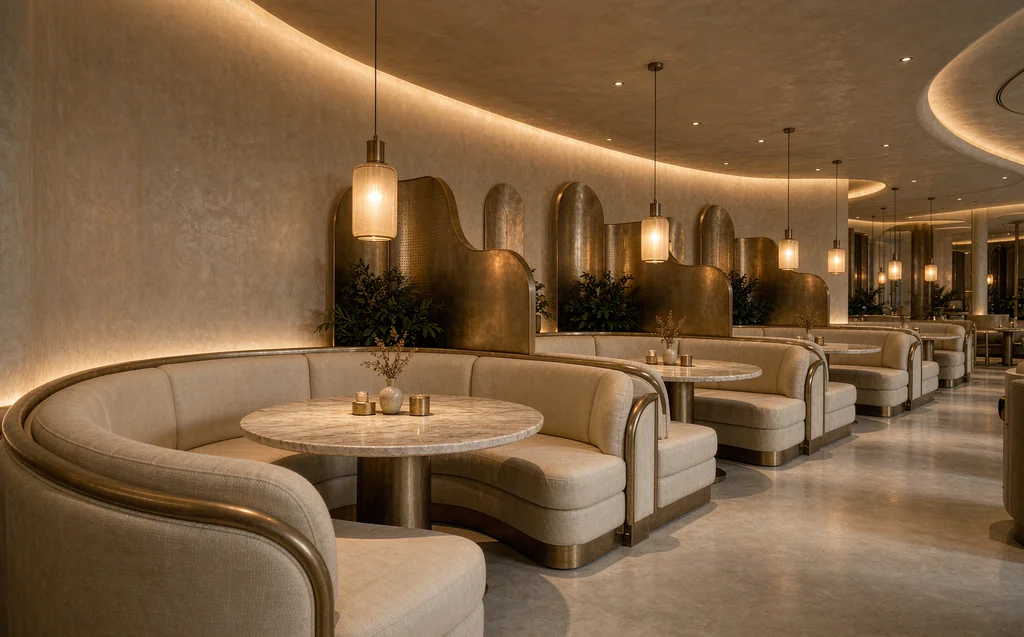
Fully custom radii are where curved booths get expensive. The practical route is modular curvature — a limited set of standard arc segments that combine into large sweeping forms, upholstered in a fabric grade matched to your traffic. A reference point for the look: our curved fabric banquette with gold metal accents shows how a wood base grounds the curve. For the seating comfort side of commercial booth seating design, foam density and back angle matter more than radius — get those right first.
Trend 3: Warm Metals — The End of the All-Grey Dining Room
The cool-grey palette that dominated the last five years is loosening up. Champagne, brushed bronze and warm brass accents are pairing with cream upholstery and wood bases, moving rooms from “tech office” back toward “evening out.” The change is visible in seating frames, table bases and booth trim more than in big architectural gestures — which makes it the cheapest trend to adopt, since accent hardware updates faster than flooring ever will.
Color psychology still applies underneath the trend: warm tones near the entrance energize, cooler neutrals calm the back of house. We covered how seating color shifts table turnover in our color psychology piece — the 2026 move is to layer that logic with warmer metallics rather than abandon neutrals entirely.
Trend 4: Designing for the Phone Camera First
More fit-out decisions are being made with a phone screen in mind. Lighting is warmer and lower, materials are chosen for how they render in photos, and focal points are designed as backdrops. For furniture, texture beats gloss: sintered stone’s matte depth, fabric’s weave, and brushed metal all photograph richer than high-gloss surfaces, which blow out under flash.
The practical rule: before approving a finish, photograph the sample under your actual dining-room lighting, not under showroom LEDs. Operators building a shortlist of modern restaurant furniture ideas should score candidates on camera behavior as well as durability.
Trend 5: Durability Is Becoming Part of the Aesthetic
The quiet trend underneath all of the above: operators are asking about frame construction, load ratings and foam density earlier in the design conversation, not after. A restaurant that stays looking new for five years is, itself, a brand signal. Pieces that look light but perform heavy — like thealloy dining chairs chains have been switching to — are engineering showing up as design. The same logic is pushing sofa-grade lounge seating into mainstream dining rooms, not just hotel lobbies: see our commercial sofa range.
Using Trends Without Dating Your Restaurant
Two rules keep a trend list from becoming a time capsule:
Trends on the surface, permanence in the bones. Upholstery colors, accent metals and tabletop finishes are cheap to revise in five years. Room geometry, booth placement and table proportions are not — get those right for your service model first, trends second.
Adopt one trend fully rather than five trends thinly. A room that commits to sintered stone tables as its signature reads as confident; a room with a bit of everything reads as a catalog.
A quick planning summary for your next supplier conversation:
Trend
Cost to adopt
Where it pays back
Skip it if…
Sintered stone tops
Medium-high
Premium positioning, reduced table maintenance
High-volume QSR with short refresh cycles
Curved booths
Medium
Dwell time, check size, photo value
Every seat must maximize wall capacity
Warm metal accents
Low
Instant palette refresh
Your brand is deliberately stark/minimal
Photo-first finishes
Near zero
Social reach, review photos
—
Contract-grade durability
Upfront premium
Year 3–5 TCO, brand consistency
Operating horizon under ~3 years
FAQ
Q1. Is sintered stone worth it for a mid-scale restaurant? If your concept sells a premium main course and you want the room to match, yes — the surface survives service conditions that age most alternatives, and it keeps doing so for years. If you run high-volume QSR with 18-month refresh cycles, laminate still makes more sense.
Q2. Are curved booths harder to clean and maintain? The frames need the same care as straight booths. Upholstery on curved sections is slightly more labor to re-cover, which is another argument for choosing a fabric grade matched to your traffic from day one.
Q3. Can we mix straight and curved booths in one room? Not only can you — most well-planned rooms in 2026 do. Straight runs along walls for capacity, curves at focal points for dwell.
Q4. How do I test a trend before committing to a full fit-out? Specify it in one zone first — a single booth cluster or a section of tables — photograph it under real service conditions for a month, then decide whether to extend.
If you’re planning a 2026 fit-out, the fastest way to pressure-test a trend is with a 3D layout of your actual floor plan before production starts. Send us your concept — you can also browse the full table and custom booth ranges to see how these trends translate into shipped product.
KONMA is a professional manufacturer of high-quality restaurant furniture, integrating independent R&D, production, sales, and service. With a skilled team, advanced equipment, and a global sales network, we provide customized furniture solutions for diverse dining environments including Asian, Western, fast-food, and café settings.
For over twenty years, we have adhered to the principles of quality and innovation, offering personalized designs, fine craftsmanship, and reliable service. Committed to continuous improvement, KONMA strives to become a leading brand in the catering furniture industry.
We warmly invite partners from all industries to collaborate for mutual success.
 English
 简体中文
 Español
 Français
 Deutsch
 Русский
 Português
 Italiano
 日本語
 한국어
 العربية
 Türkçe
 Tiếng Việt
 ไทย
 Indonesia
 Melayu