Home / News / Industry Dynamics / The Hidden Cost of Cheap Restaurant Furniture: A 5-Year TCO Breakdown
The Hidden Cost of Cheap Restaurant Furniture: A 5-Year TCO Breakdown
2026-11-03
Every furniture quote looks reasonable on the day it arrives. Two suppliers, two sets of numbers, and the cheaper one usually wins the order. In restaurant fit-outs, that decision is made under deadline pressure with a budget already stretched by kitchen equipment and the build-out.
The problem is that the cheaper quote is rarely the cheaper furniture. Cheap restaurant furniture carries costs that never appear on the invoice — they show up in year two as wobbly frames, in year three as a partial replacement order, and in year four as a dining room that photographs worse than the one your competitor opened across the street. This article lays out a five-year restaurant furniture total cost of ownership (TCO) framework you can run on any quote before you sign it.
Why the Sticker Price Tells You Almost Nothing
A dining chair is not décor. In a commercial dining room it is production equipment — picked up, leaned back on, dragged across tile, wiped down with industrial cleaner, and repeated several hundred times a week. This is where contract grade vs residential furniture stops being marketing language and becomes an engineering difference:
Residential furniture is built for a family of four eating dinner.
Contract-grade furniture is built for 150 covers a night, every night.
When you compare two quotes by price alone, you are comparing the only number the invoice shows, while everything that actually determines cost — frame construction, foam density, joint method, finish thickness — is invisible in it.
The Five Costs That Hide Behind a Low Quote
1. Repair labor that never stops
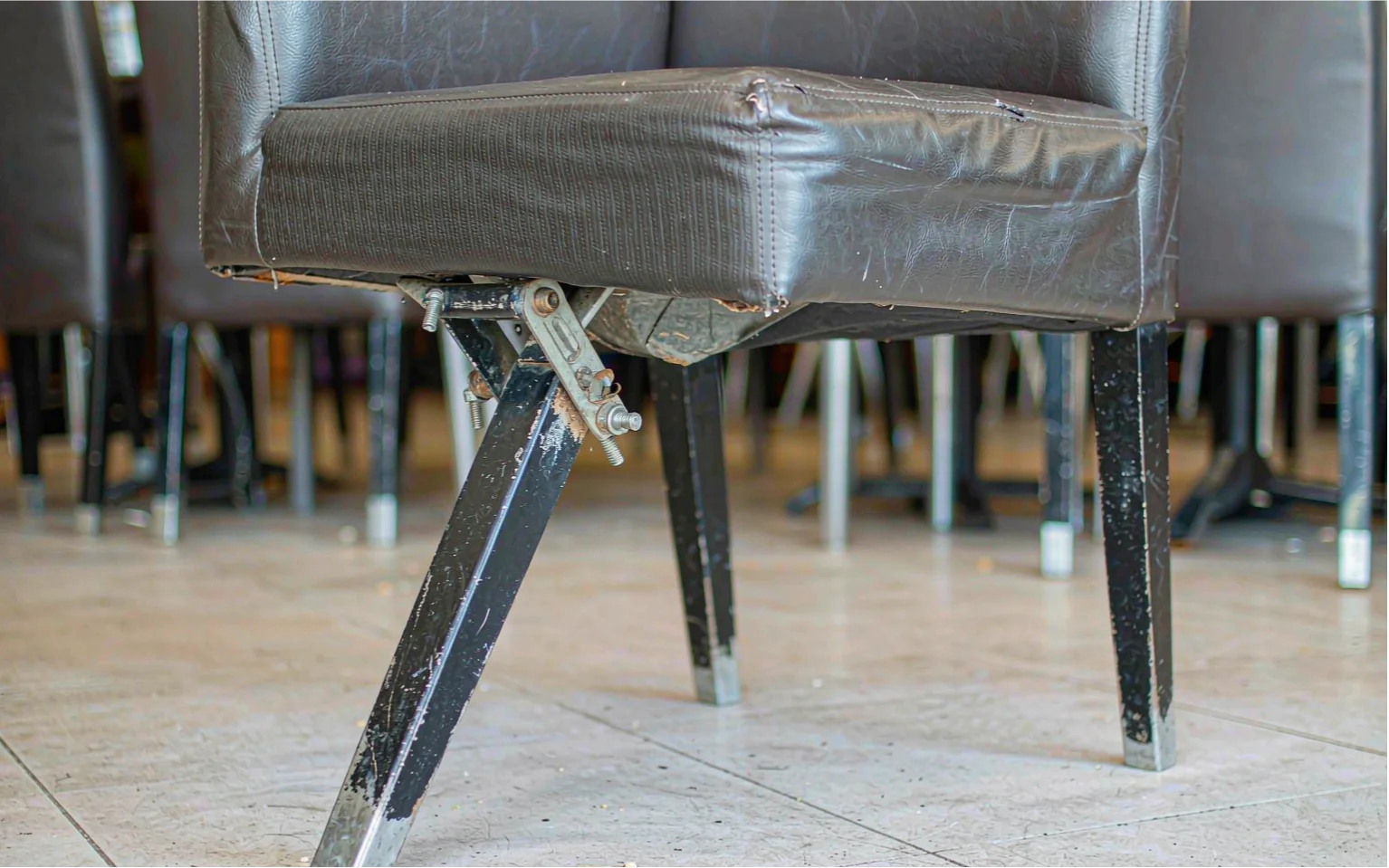
Low-cost chairs fail at predictable points: glued joints that loosen, foot glides that snap off, seat pans that crack where the screws bite. Each fix takes a maintenance person twenty minutes, which is exactly why nobody tracks it. Twenty minutes a week across a 120-seat room quietly becomes a part-time job by year two.
A useful sourcing test: ask the supplier which joints are glued and which are bolted or welded. Bolted joints can be re-tightened by your own staff; glued joints can only be re-glued, usually badly. The failure points you tolerate here are what shorten the commercial dining chair lifespan from a decade to a couple of seasons.
2. Partial replacement cycles
Furniture in a dining room does not fail uniformly. Window-side chairs take sun damage; booths near the kitchen take staff traffic. Within three years you are not replacing a set — you are replacing a percentage of one, and the replacements rarely match what has faded around them. That irregular restaurant furniture replacement cycle is how dining rooms end up with three slightly different shades of the same chair.
3. Downtime and disruption
Every replacement wave has a hidden schedule cost: deliveries during service hours, sections of the room closed off, booths out of commission. If the furniture lasts longer, this disruption never happens. If it fails sooner, you pay twice — once for the furniture, once for the seats you could not sell while swapping it.
4. The brand tax
Your seating appears in every photo your guests take — behind every review, every Reel, every “new favorite spot” post. Upholstery that pills, vinyl that cracks at the seams, frames with chipped powder coating do not generate complaints; they just lower the perceived price point of everything on your menu. Nobody leaves a one-star review saying “the foam density was insufficient.” They just stop suggesting your place for anniversaries.
5. Re-ordering overhead
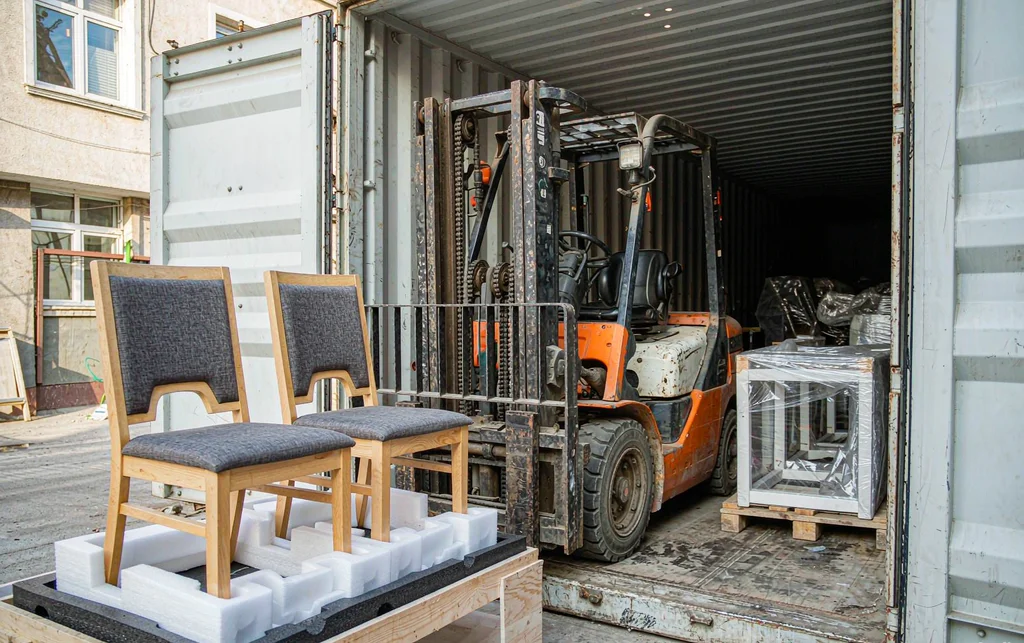
Buying cheap once often means buying twice — a second round of freight, customs clearance, receiving, and coordination with a supplier who may have discontinued the model. The second order is smaller, so per-unit freight and handling cost more.
A 5-Year TCO Example: Two Ways to Furnish a 120-Seat Room
Run it on any two quotes. The table below uses deliberately round illustrative numbers — replace them with your own:
Year
Budget Set A ($45/chair)
Contract-Grade Set B ($85/chair)
What moved Set A’s number
1
$50/seat (incl. freight & install)
$96/seat
—
2
$72/seat
$99/seat
First joint failures, repair labor
3
$108/seat
$102/seat
~50% partial replacement + second freight run
4
$130/seat
$118/seat
Re-upholstery batch (Set B); mismatched shades (Set A)
5
$175/seat (re-fit budgeted)
$121/seat
Set A enters a full replacement cycle
The crossover lands around year two to three. The exact point depends on your covers-per-night and labor rates — which is precisely why running the formula on your own numbers beats trusting anyone’s claim, including ours.
How to Read a Furniture Quote Like a Procurement Pro
1. Ask what is inside the frame
Four questions, one email:
#
Question
What the answer tells you
1
What is the tube gauge on metal frames?
Structural headroom under dynamic load
2
What timber and joinery for wood frames?
Whether joints survive humidity swings
3
What foam density (kg/m³) in upholstered seats?
How long the seat looks new
4
How does the seat attach to the frame?
Whether repairs are bolted or glued
A supplier who answers these four in one email is a different category of supplier from one who sends another render.
2. Ask which tests the product has actually passed
For commercial seating the relevant ones are static load, fatigue/durability cycling, and for upholstered items, flammability standards for your market. You don’t need to memorize standards — you need a supplier who can name them without checking. Our guide to factory audit details covers how to verify this before wiring a deposit.
3. Compare cost per seat-year, not cost per seat
Divide total five-year cost by (number of seats × 5). A 45 chair lasting 2.5 years costs **18 per seat-year** before repairs — a number that usually loses to contract grade, and the single ratio that cuts through every marketing claim on both quotes.
When a Low Price Is Actually the Right Call
To be fair to the budget option, not every project needs five-year furniture:
A kiosk with a 12-month lease
A seasonal rooftop that closes in winter
A pop-up concept that will be redesigned anyway
In these cases, paying for contract-grade durability is spending money on a lifecycle you will not use. Match the specification to the lease, not the industry norm. The expensive mistake is not buying cheap furniture — it is buying cheap furniture for a room you plan to operate for a decade.
FAQ
Q1. How long should commercial restaurant furniture last?
Contract-grade tables and chairs in a high-traffic dining room should realistically serve 5–10 years with basic maintenance. If a quote is priced like residential furniture, expect a commercial dining chair lifespan closer to 18–30 months before visible failures.
Q2. Is expensive restaurant furniture always the better buy? No. For short leases, seasonal venues and pop-ups, budget furniture matched to a short lifecycle is the rational choice. TCO analysis only favors the higher upfront quote when your operating horizon exceeds roughly three years.
Q3. What is the most common early failure point in cheap dining chairs? Joints and seat attachment. Glued joints loosen under rocking loads, and thin seat pans crack at screw points. Each failure is individually repairable — the cost is the accumulation, not any single breakdown.
Q4. How do I calculate cost per seat-year for a furniture quote? Add purchase price, freight, installation, estimated repairs, and any replacement cost over your planning horizon, then divide by seats and years. A chair that costs half but lasts a third as long is 50% more expensive per seat-year.
The Takeaway
The quote is the smallest number in the decision. Before your next fit-out, put both suppliers through the five-line TCO formula, ask the four frame questions, and check the cost per seat-year. Ten minutes of arithmetic protects a five-year dining room.
KONMA is a professional manufacturer of high-quality restaurant furniture, integrating independent R&D, production, sales, and service. With a skilled team, advanced equipment, and a global sales network, we provide customized furniture solutions for diverse dining environments including Asian, Western, fast-food, and café settings.
For over twenty years, we have adhered to the principles of quality and innovation, offering personalized designs, fine craftsmanship, and reliable service. Committed to continuous improvement, KONMA strives to become a leading brand in the catering furniture industry.
We warmly invite partners from all industries to collaborate for mutual success.

 English
 简体中文
 Español
 Français
 Deutsch
 Русский
 Português
 Italiano
 日本語
 한국어
 العربية
 Türkçe
 Tiếng Việt
 ไทย
 Indonesia
 Melayu