Home / News / Industry Dynamics / Commercial Outdoor Furniture: Frames, Fabrics and Finishes That Survive UV, Rain and Salt Air
Commercial Outdoor Furniture: Frames, Fabrics and Finishes That Survive UV, Rain and Salt Air
2026-11-09
Outdoor seating used to be the overflow zone — a few tables by the door for guests who wanted to smoke or wait. In most markets it now carries a real share of covers, and in some it is the reason people choose the venue at all. It is also the part of a restaurant’s furniture package that ages fastest. Not because rain is hard on furniture, but because outdoor pieces face three forces at once that indoor pieces never meet: ultraviolet light, constant wet-dry cycling, and salt or chlorine carried in on the air and off guests’ skin.
This guide is written for operators specifying commercial outdoor restaurant furniture — what actually fails, which frames and fabrics hold up, and how to match the specification to your climate instead of to a catalogue photo.
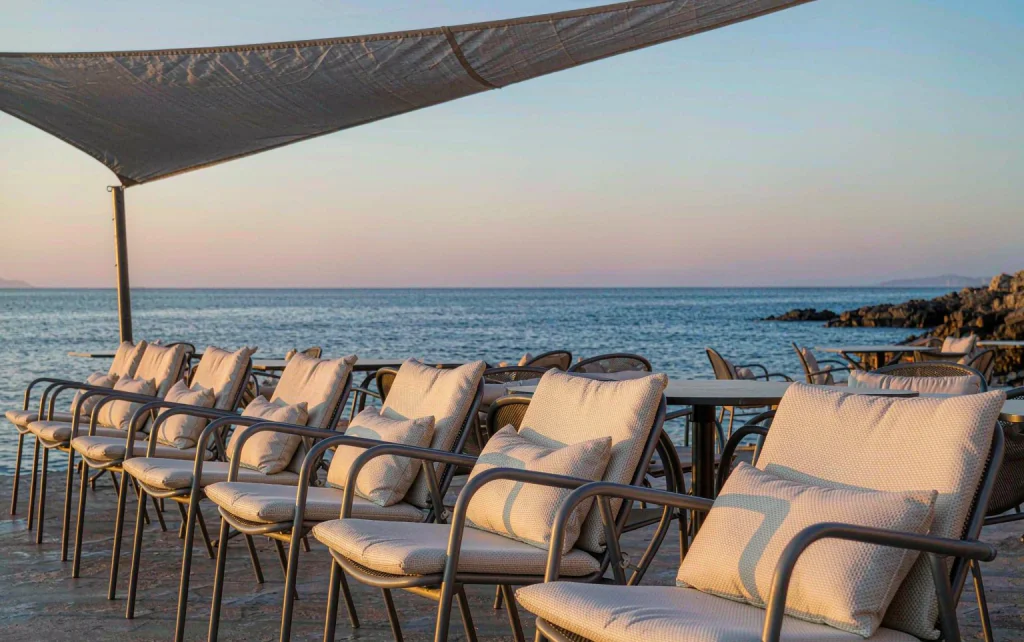
Terrace seating takes three times the environmental load of an indoor dining room.
Why Outdoor Furniture Fails Faster Than Indoor Furniture
Three forces do most of the damage, and they work together.
UV radiation breaks down polymer chains in coatings, resins and synthetic fibres. Powder coating chalks and fades; PVC webbing goes brittle; foam turns to dust inside a cushion that still looks fine from outside.
Wet-dry cycling is harder on a frame than constant wetness. Water enters a joint or a screw hole, expands the material slightly, then evaporates — and repeats that cycle several hundred times a season. This is how welds crack and timber moves.
Salt and chlorine accelerate corrosion at exactly the points that are hardest to inspect: screw threads, weld seams, and the underside of a tabletop.
Add daily commercial cleaning — often with stronger chemicals than a home patio ever sees — and the maintenance assumptions baked into residential outdoor furniture stop applying. If you have already read our breakdown of restaurant furniture total cost of ownership, this is the same logic applied to the terrace: the cheap set does not fail dramatically, it just fails two years early, in a place every guest walks past.
Frames: What Holds Up and What Only Looks Like It Will
Frame type
Strength
Weak point outdoors
Best for
Powder-coated aluminium
Will not rust; light enough for staff to move
Coating chips at ground contact points
Coastal, high-UV, high-turnover terraces
Mild steel, powder-coated
Higher rigidity, lower material cost
Rust starts at any coating breach or weld
Covered patios, dry climates only
Hot-dip galvanised steel
Heavy-duty corrosion resistance
Heavy; industrial look unless over-coated
Rooftop bars, public plazas
Teak / dense hardwood
Ages gracefully, repairable, premium look
Needs oiling; moves with humidity
Premium terraces, temperate climates
HDPE synthetic rattan
UV-stabilised, colour goes through the strand
Frame underneath still decides the lifespan
Resort and lounge settings
Aluminium, specified properly
Two details separate a terrace chair that lasts five seasons from one that lasts two. The first is wall thickness — a thin tube dents at the seat rail where guests push back to stand. The second is how the coating is applied: a properly pre-treated, baked powder coat flexes with the frame; a cheap spray job cracks at the first impact and lets moisture into the joint.
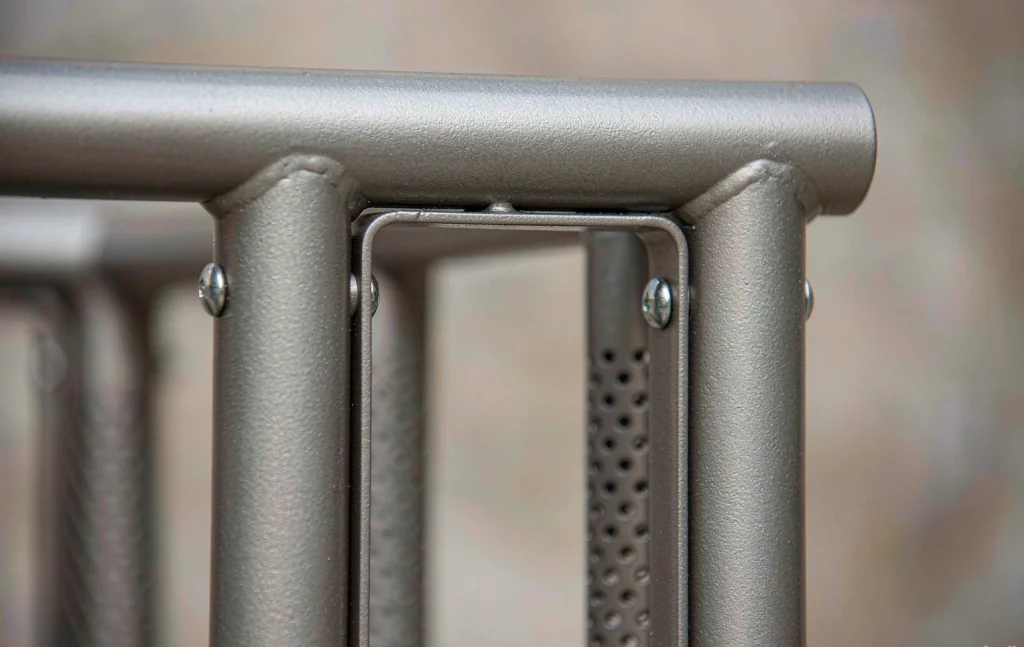
The joint is where outdoor frames fail first: coating coverage and screw material matter more than the tube itself.
Steel is not disqualified — it is just conditional
Powder-coated steel is stiffer and cheaper, and it is the right answer for a covered patio in a dry climate. The condition is absolute: one scratch through the coating on a coastal terrace, and rust starts working under the paint where you cannot see it. If your site gets salt air, do not buy steel and hope.
Wood outdoors: a maintenance contract, not a material choice
Teak and dense hardwoods survive weather by being maintained — oiled on a schedule, sanded when grey. That is a perfectly reasonable trade for a premium terrace where the wood is part of the look. It is a bad trade for a 60-seat chain patio where nobody owns that task. For a deeper comparison of timber against metal in heavy-use rooms, see our piece onsolid wood vs. metal restaurant furniture.
Fabrics and Cushions: What “Outdoor Grade” Actually Means
The label “outdoor fabric” covers everything from genuinely UV-stable woven acrylic to polyester with a water-repellent spray that washes off in a month. Three specifications separate them:
Solution-dyed fibre. The pigment is added to the polymer before the fibre is extruded, so colour cannot fade out of the surface — because it is not on the surface. Printed or piece-dyed fabrics fade from the top down.
Quick-dry foam. Standard foam holds water and grows mould inside the cushion. Open-cell quick-dry foam drains and dries within hours, which is the difference between a cushion you can leave out and one you must bring in every night.
Mould and mildew treatment. Necessary in humid and tropical markets; a nice-to-have in dry ones.
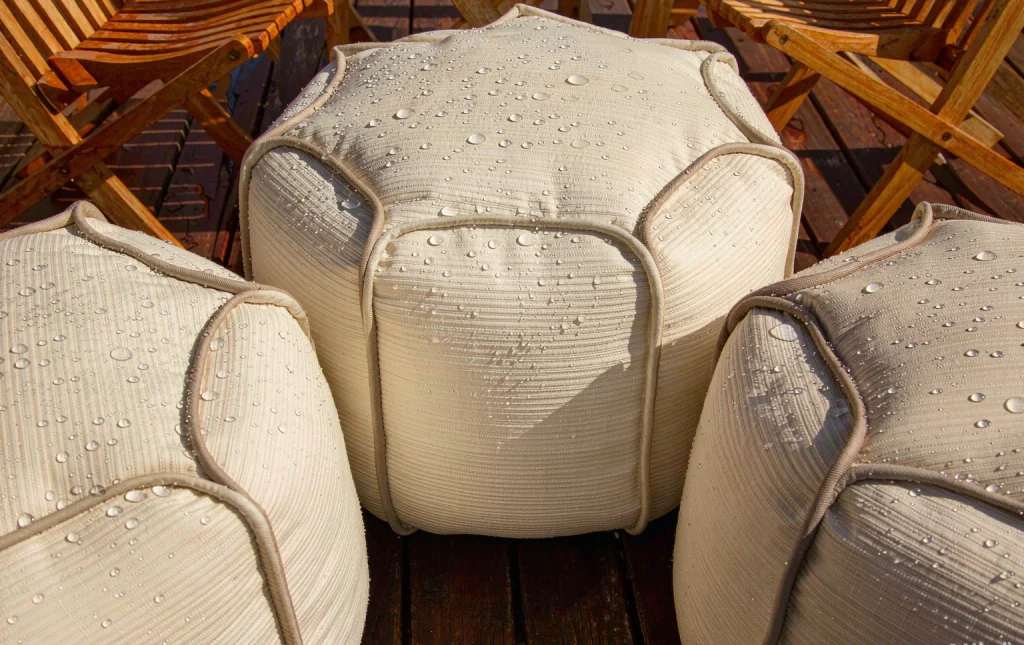
Water beading on solution-dyed acrylic — the finish is repellent, but the fibre structure is what keeps the colour.
One practical rule: if cushions are removable, your staff will remove them, and the furniture will last longer. If they are fixed, they must be specified as fully outdoor-rated from the foam out — not just in the cover fabric.
Finishes and Small Parts: Where Terraces Actually Fail
Almost every premature failure I see on an outdoor project traces back to a component worth less than the labour to replace it.
Screws and bolts. Use stainless, and match the grade to the environment — 316 for coastal and poolside, 304 for inland. Mixing stainless hardware into an aluminium frame is fine; mixing plain steel into anything is not.
Glides and feet. The contact point with the ground takes the most abrasion and the most standing water. Nylon glides with drainage gaps beat solid rubber pads.
Tabletops. Solid surface, compact laminate and ceramic tops all handle weather; MDF-core tops with edge banding do not, however good the laminate looks in a sample book.
Matching the Specification to Your Climate
Climate / site
Frame
Cushion & fabric
Non-negotiable detail
Coastal / salt air
Aluminium, thicker coat
Solution-dyed acrylic, quick-dry foam
316 stainless hardware
Tropical, heavy rain
Aluminium with drainage-friendly joints
Removable covers, mould-treated foam
No water traps in the seat frame
Hot, dry, high UV
Aluminium or teak
Light colours, UV-stable weave
Fade resistance verified, not assumed
Cold winters, seasonal use
Aluminium; stackable if space is tight
Store cushions indoors
Freeze-thaw stability at joints
This is also why terrace design and interior design should be specified together. The material logic that works inside — the matte stone tops and warm metals we wrote about in our 2026 restaurant design trends piece — can often continue outside, but only if the outdoor version of each material is specified rather than assumed.
Maintenance That Buys Years
None of this is complicated; the failure is almost always that nobody owns the task.
Weekly: rinse frames and tabletops with fresh water to remove salt and cleaning residue; wipe joints dry.
Monthly: check every screw and glide; replace missing feet before they become scratched frames.
Seasonally: inspect coating edges for chips and touch in immediately — a 2 mm chip becomes a rust bloom in one season.
Before winter (or the rainy season): stack or cover, and store cushions dry. Storing them damp is worse than leaving them out.
Frequently Asked Questions
How long should commercial outdoor furniture last?
With correct specification and a written maintenance routine, five to eight years on a coastal site is realistic. Two to three years is typical when residential-grade pieces are bought for commercial use — and the failure usually appears at joints and hardware rather than in the visible frame.
Is aluminium strong enough for a busy terrace?
Yes, provided the wall thickness suits the load and the frame is properly braced. Light weight is an operational advantage here: staff resetting a terrace twice a day handle every chair. We covered the same weight-to-strength logic indoors in our article onlightweight alloy dining chairs at 3.5 kg with a 200 kg load rating.
Can indoor chairs and tables be used outside?
Under a permanently covered area with no wind-driven rain, sometimes — but the foam, the fabric backing and the frame coating are all specified for indoor humidity levels. On an open terrace, expect failure within one to two seasons, most often in the seat foam before the frame.
Should we buy stackable or fixed outdoor furniture?
Stackable, if you close the terrace at night, host events, or need to store furniture in the off-season. Fixed pieces look better and resist wind better, but they commit you to one layout. Most operators mix: fixed banquette-style benches at the perimeter, stackable chairs elsewhere.
Specifying the Terrace Before You Order
If outdoor covers are part of your next project, the useful first step is not a product list — it is a plan drawing with the site conditions marked: sun path, prevailing wind, drainage, distance from salt water, and who will handle maintenance. Bring that to a supplier and the specification writes itself.
Browse our commercial outdoor furniture range, or send us your terrace plan for a 3D layout before production. Indoor seating lines are in the commercial chair collection.
KONMA is a professional manufacturer of high-quality restaurant furniture, integrating independent R&D, production, sales, and service. With a skilled team, advanced equipment, and a global sales network, we provide customized furniture solutions for diverse dining environments including Asian, Western, fast-food, and café settings.
For over twenty years, we have adhered to the principles of quality and innovation, offering personalized designs, fine craftsmanship, and reliable service. Committed to continuous improvement, KONMA strives to become a leading brand in the catering furniture industry.
We warmly invite partners from all industries to collaborate for mutual success.

 English
 简体中文
 Español
 Français
 Deutsch
 Русский
 Português
 Italiano
 日本語
 한국어
 العربية
 Türkçe
 Tiếng Việt
 ไทย
 Indonesia
 Melayu