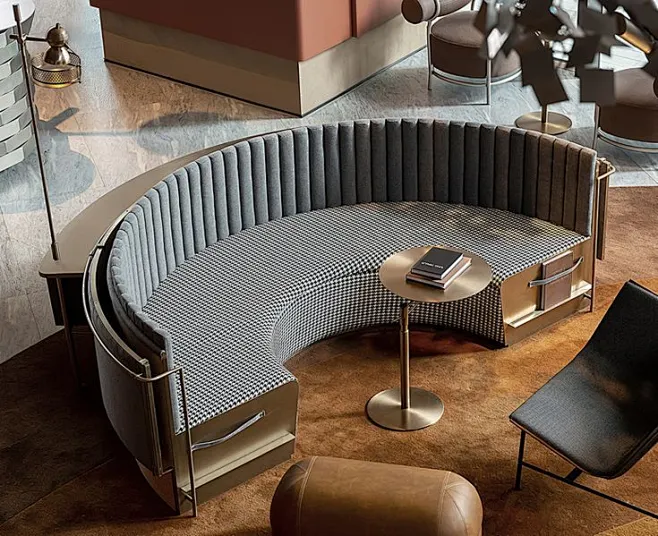
Curved sofas and circular banquettes are widely favored in commercial spaces for their elegant curved lines, which create a relaxing atmosphere and enhance spatial privacy. However, many newly renovated projects fail fire inspections simply because the curved edges of seating narrow down walkways. Rework leads to extra costs and delays normal operation. Is there really no way to combine stylish design with safety rules? With reference to internationally recognized safety codes and practical experience, we can achieve a win-win result.
From numerous commercial space design projects, we find that rejections of curved sofas and circular banquettes rarely result from the curved shape itself. Most failures stem from design misunderstandings and neglect of international standards. The three common misconceptions below are the key focus of official inspections.
Many designers judge the minimum aisle width for banquette seating merely by measuring diagonal distances on blueprints, which is a widespread design error. In accordance with NFPA 101 Life Safety Code, the net width of main evacuation aisles in commercial venues is clearly regulated: no less than 1.1 meters for regular areas, and 1.4 meters or above for high-traffic zones.
The tangent points along curved banquettes are always the narrowest sections of walkways. Even if the overall space is spacious, insufficient width at these points will make evacuation routes non-compliant. Given the features of curved structures, aisle width must be measured section by section instead of relying on rough diagonal data.
Accessibility is a mandatory rule for commercial spaces worldwide. The ADA Accessibility Standards set strict requirements for ADA-compliant curved banquette layout: a dedicated wheelchair turning area with a diameter of 1.52 meters must be reserved, and this area shall never overlap with evacuation aisles.
Recessed circular banquettes tend to occupy wheelchair maneuvering space. Some have overly narrow entrances that block wheelchairs, while others lack enough inner depth for wheelchairs to turn around. These hidden problems frequently cause inspection failures on site.
Tall curved sofas create private zones with continuous upholstery, yet large fabric and foam surfaces become potential combustible areas that speed up fire spread. Different regions have specific fire resistance regulations: products for North America need to comply with NFPA 260 Standard for Upholstered Furniture, while European markets require conformity with BS 5852 and EN 1021 fire safety standards.
Many designers only focus on the fire resistance of surface fabrics, ignoring inner foam and lining materials. As a composite structure, a banquette can only pass multi-regional fire inspections when all components meet fire-retardant requirements.
Three mainstream types of curved banquettes have distinct advantages in compliance, space utilization and user experience. You can select the proper style based on venue size and passenger flow. The table below lists core reference indicators:
| Banquette Type | Fire Compliance Difficulty | Space Utilization | Seating Privacy | Wheelchair Access Performance | Maximum Evacuation Distance | Renovation Cost | Applicable Scenarios |
|---|---|---|---|---|---|---|---|
| Peninsula Curved Banquette | Low | Medium | Good | Excellent | Short | Low | Wall areas, small & medium-sized commercial spaces |
| Freestanding Circular Island Banquette | Moderate to High | High | Excellent | Average | Medium | Moderate to High | Spacious halls, central feature areas |
| Sectional Curved Combined Banquette | Medium | Relatively High | Good | Good | Controllable | Medium | Large comprehensive venues, multi-functional zones |
Peninsula banquettes are fixed against walls with plenty of open sides, forming natural and unobstructed evacuation routes. Freestanding circular banquettes serve as visual highlights and require two symmetrical entrances on curved edges to remove passage barriers. Sectional styles divide a full curve into independent modules with standard walkways in between, delivering strong adaptability to irregular spaces.
Frames, fabrics, fillers and partitions all play vital roles in making fire-rated curved sofas fully compliant. Referencing NFPA, BS and EN international standards, we have compiled a practical checklist:
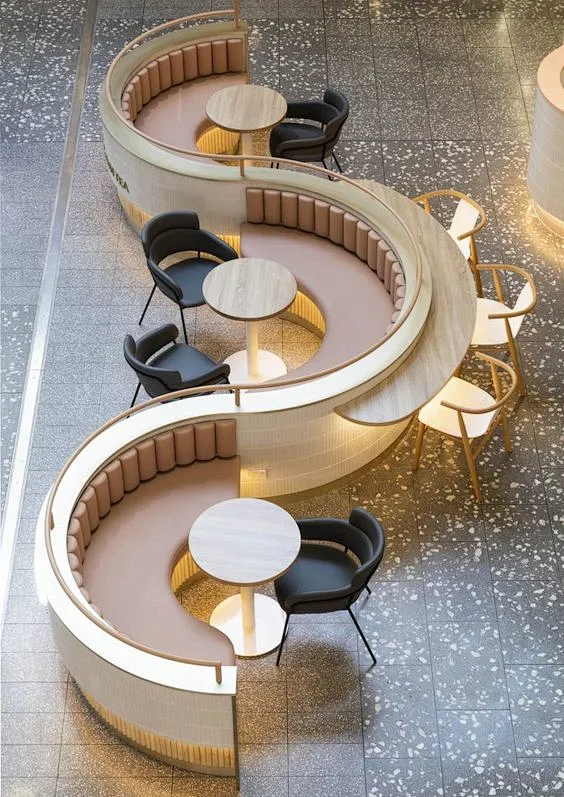
A local comprehensive leisure venue once faced fire inspection failure on its fully enclosed circular banquettes. Three main issues were identified: only one entrance was designed, aisle width at curved tangent points was below standard, and fully enclosed tall partitions blocked smoke detectors.
Instead of dismantling the entire seating set, the team carried out targeted optimization. The complete circular structure was split into two separate curved sofa modules, with evacuation aisles built between them in strict accordance with NFPA 101. Fully closed tall partitions were replaced with semi-transparent fire-resistant ones, preserving the original design style while ensuring normal operation of fire facilities.
All adjustments were finished within one week, and the venue passed the re-inspection smoothly with its original layout and visual effects well retained. This case proves that designing in line with international codes at the early stage is far more efficient than post-completion rework.
We receive numerous questions about design and compliance from industry practitioners. Below are answers to frequently asked questions based on global fire and accessibility codes:
Q: Can curved banquettes pass fire inspections in different regions?
A: Definitely. Curved design itself is not against regulations. As long as the full length of evacuation aisles complies with NFPA 101, evacuation distance stays within regulated limits, and all materials meet fire-retardant standards including NFPA 260, BS 5852 and EN 1021, curved sofas and circular banquettes can be fully compliant. It is recommended to integrate relevant codes into early design.
Q: What is the minimum aisle width required around banquettes?
A: Per NFPA 101, the net width of main aisles shall be no less than 1.1 meters in regular commercial areas, and 1.4 meters or above in busy zones. Special attention shall be paid to the narrowest tangent points of curved banquettes, which are core inspection checkpoints.
Q: How to make curved banquettes comply with both fire codes and ADA standards?
A: First, set aside an independent 1.52-meter diameter wheelchair turning area that never overlaps with evacuation aisles. Second, widen banquette entrances to fit wheelchair size. Third, reserve sufficient inner depth to ensure wheelchairs can turn around freely.
Q: Do all upholstery materials for tall curved sofas need fire-retardant treatment?
A: Yes for most commercial applications. Continuous upholstery is classified as a high fire risk area. Fabrics, foam and liners must all conform to local fire resistance standards.
After finalizing design plans, verify key details with manufacturers before ordering curved sofas and circular banquettes to avoid compliance risks. As an experienced commercial furniture supplier, Konma suggests focusing on the following six points:
As a professional commercial furniture manufacturer, Konma integrates mainstream global fire and accessibility codes into every phase of product development. Our curved sofas and custom circular banquette series follow international standards in structural design, material selection and layout guidance. We retain the elegant charm of curved shapes while helping commercial spaces pass fire inspections across regions effortlessly. Style and safety can always go hand in hand, and professional products will make creative designs land steadily.
Why is the matching of sofas in themed Western restaura […]
1. Core Points for Choosing High-End Café Tables & […]
In 2026, more and more people pay attention to the crea […]
Most catering venues suffer from sharp outdoor passenge […]
Related links:
About us Company News Industry Dynamics Table Chair Outdoor-furniture Sofa Latest dining chair Other SSL 100% Secure Transactions